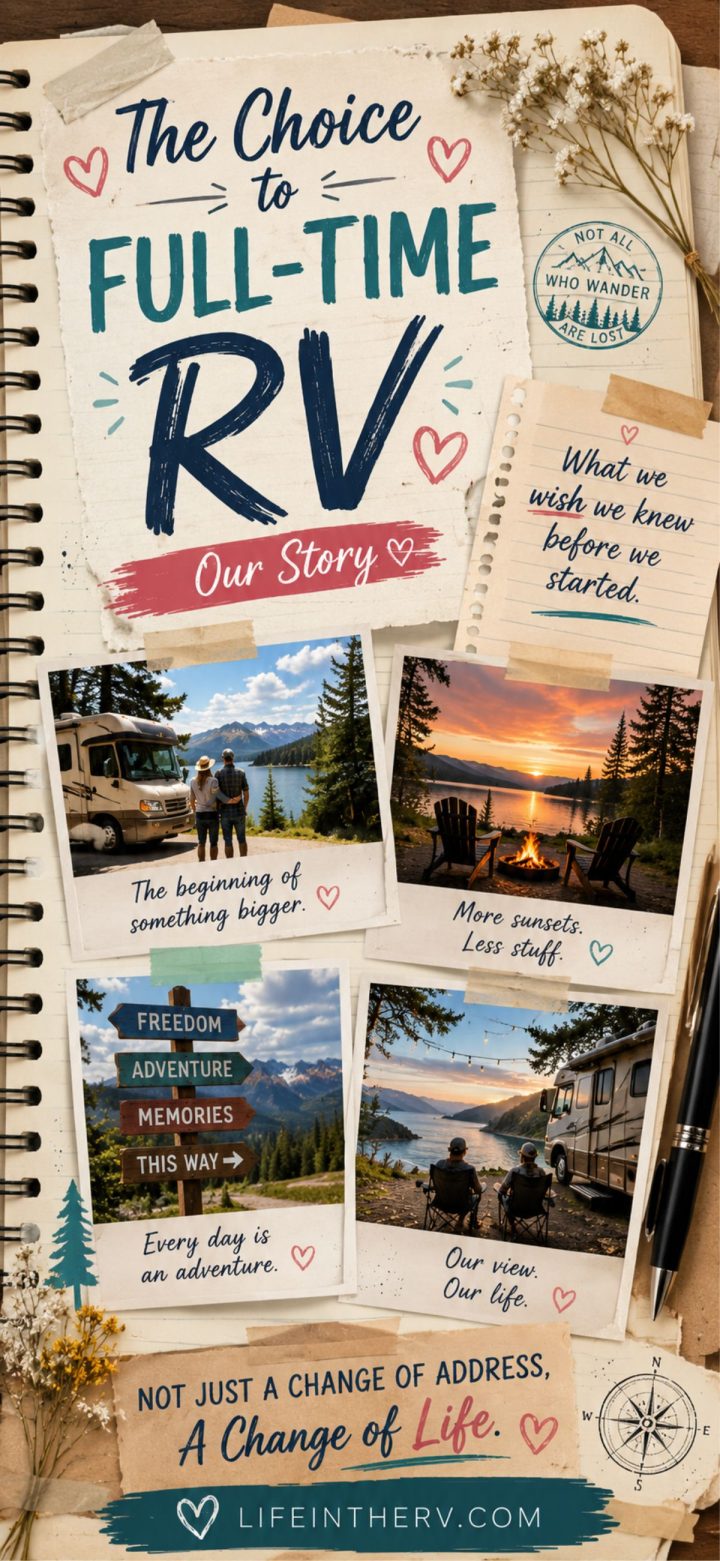
The Choice to Full Time RV
We went from a house to full time RV in 6 weeks. Here’s how we made the choice, the mistakes we made, and what we wish we knew.
Why Did We Choose Full-Time RV Living?
We chose full-time RV living because we wanted more freedom, more time with family spread across the country, and the opportunity to experience life now instead of waiting for “someday.” Nine years later, we still believe it was one of the best decisions we’ve ever made.
Making the choice to live full-time in an RV was one of the best decisions Tim and I ever made, and we made it in about six weeks flat.
July marks 9 incredible years since we packed up our lives, sold most of what we owned, and hit the road in a brand-new 5th wheel. We went from a house to full-time RVers faster than most people plan a vacation, and we haven’t looked back once.

If you’re sitting on the fence about full-time RV living, this post is for you. I’m sharing exactly how we made the leap, what we wish we’d done differently, and what life on the road has looked like for us ever since.
🔑 Key Takeaways: Making the Choice to Full-Time RV
- We went from house to full-time RVers in just 6 weeks
- Financial prep, downsizing, and finding the right rig are the three biggest hurdles
- The decision was made after years of watching other RVers — and finally deciding “someday” had to be now
- Our biggest regret: putting things in a POD instead of letting them go
- 9 years later, full-time RV living is still the best decision we ever made
If you’re ready to dive into the nuts and bolts of making it work, check out our complete guide on how to RV full time, but start here first.

Why Did We Decide to Live Full-Time in an RV?
In July 2017, we finally decided we needed a change. We took a leap of faith and committed to picking up a brand-new RV by the end of the month.
We knew one thing for certain: if we didn’t do it then, we might never do it at all.

That fear of “someday never coming” was real for us. We had watched people we loved put off their dreams, waiting for the perfect moment, and that moment never arrived. We refused to let that be our story.
So after talking it over, we decided to go for it. It made sense in so many ways. We have family spread across the United States from New York to California, and full-time RVing meant we could see them all, on our terms, on our timeline.

Choosing to live full-time in an RV is a decision that can lead to a remarkable journey filled with adventure, freedom, and discovery. For many people, it’s a lifestyle that offers the chance to explore new places, meet incredible people, and embrace a simpler, more intentional way of living.
The decision isn’t impulsive for most people; it involves a lot of thought about finances, lifestyle, and personal goals. Some are drawn to constant travel. Others crave community and connection on the road. For us, it was both.
How Did We Find the Right RV?
To get started on this adventure, we had to find the perfect fit for us, and that took more searching than we expected.
We visited local dealerships and checked out RVs of all shapes and sizes. I knew going in that I wanted one with a washer and dryer (non-negotiable, we’d had one back in New York and I wasn’t giving that up). But the perfect one just wasn’t showing up locally.
So I went online.
I found quite a few options, but one stood out immediately: a 2017 Keystone Alpine 3301GR 5th wheel.

It checked every single box:
- Not oversized
- Large windows (I need lots of natural light!)
- Washer/dryer combo unit
- Built for four seasons
- Tons of counter space
- A desk area for writing
- A dishwasher — YES!
I was completely in love. And lucky for us, it was located in Cincinnati, Ohio, right on our way to New York.
This is a picture of our RV that we had moved to our land, so we had somewhere to stay when we visited. It’s a little dirty from going through a good old New York winter.

What Are the Financial Considerations of Full-Time RV Living?
There was just one problem: our truck, which was only two months old, wasn’t going to pull it. UGH.

That sent us back to the drawing board financially, and honestly, it’s a great reminder that the costs of full-time RV living go beyond just the price of the rig.
Living in an RV full-time can absolutely be more affordable than traditional homeownership, but it still requires careful budgeting and planning. Here’s what you need to factor in:
- RV purchase or financing — new vs. used, and what you can realistically tow
- Tow vehicle — don’t underestimate this one (ask us how we know)
- Campground fees — nightly rates, monthly stays, memberships like Harvest Hosts or Thousand Trails
- Fuel costs — a big variable depending on how much you move
- RV insurance
- Maintenance and repairs — budget for the unexpected because it will happen
- Health insurance — often the biggest expense for full-time RVers
We ended up buying a new truck to pull our 5th wheel, had a hitch installed, and rented a small U-Haul trailer for the move. (Pro tip: make sure everything in that U-Haul can actually fit inside the RV before you load it up.)

Financial considerations are also crucial.
Living in an RV full-time can be more affordable than traditional homeownership, but it still requires careful budgeting and planning.
You’ll need to consider the cost of purchasing or renting an RV, as well as ongoing expenses such as fuel, campground fees, maintenance, and insurance.
How Do You Downsize to Move Into an RV?
This is where things got real, and where we made some of our biggest early mistakes.
We held an open-house yard sale and sold as much as we could. Whatever was left, we put into a POD storage unit.

Big mistake. More on that in a future post. 😉
The short version: if you’re serious about full-time RV life, let things go. Holding onto a storage unit “just in case” costs money every single month and keeps you emotionally tethered to stuff you’ll probably never use again.
Downsizing is one of the most emotionally challenging parts of the transition, but also one of the most freeing. We cover this in depth in our Downsizing for RV Life guide if you want the full breakdown.

Is Full-Time RV Living Worth It?
Nine years in, and the answer is still a resounding yes.
Choosing to live in an RV full-time is a journey of self-discovery and exploration. It’s about stepping outside your comfort zone, embracing uncertainty, and opening yourself up to the endless possibilities that life on the road has to offer.

Tim and I have traveled through more than 40 states together. We’ve woken up to ocean views, mountain sunrises, and desert sunsets. We’ve had Thanksgiving dinner surrounded by family across the country and Christmas mornings parked somewhere beautiful.
The sense of freedom that comes from exploring different places while spending time with the people you love is incomparable.
If you’re asking yourself any of these questions:
- Am I seeking more freedom and flexibility in my life?
- Do I crave adventure and new experiences?
- Am I willing to downsize and embrace a simpler lifestyle?
…then full-time RV living might be exactly what you’ve been looking for.
Don’t wait for the perfect moment. Take the first imperfect step. That’s the only way this life begins.
📌 Be sure to follow us on Pinterest and PIN IT FOR LATER!

Frequently Asked Questions About Choosing to Full-Time RV
It varies widely, but we made the transition in about 6 weeks from decision to departure. Most people take anywhere from 3 months to a year. The biggest time factors are selling your home (or ending a lease), downsizing your belongings, and finding the right RV. The more flexible you can be, the faster it can happen.
Full-time RV living costs vary based on your RV, how much you travel, and your lifestyle. Many full-timers spend between $2,000–$4,000/month covering campground fees, fuel, food, insurance, maintenance, and health insurance. Some spend less by boondocking or using campground memberships. We share a breakdown in our RV Living Cost Calculator.
Not necessarily. Some people rent their home while RVing full-time, which can help offset costs. Others sell and use the proceeds to purchase their rig outright. We sold, and for us it was the right call, it made us fully commit to the lifestyle.
This depends on your lifestyle, budget, and towing situation. 5th wheels and Class A motorhomes are popular for full-timers because of the space and livability. Class C and Super C motorhomes (like our current Jayco Seneca) offer a great balance of size and driveability. There’s no single right answer; the best RV is the one that fits your needs and that you can actually afford to operate.
The most common ones we see (and have lived): underestimating towing capacity, keeping a storage unit “just in case,” packing too much, not budgeting for repairs, and waiting too long to make the leap. We’ve made most of these ourselves, which is why we write about them!
Absolutely, and thousands of people do. Remote work has made full-time RVing more accessible than ever. Good campsite WiFi, mobile hotspots, and co-working spaces on the road make it very doable. We cover remote work for RVers in detail on the blog.
Ready to stop dreaming and start planning? Grab our free RV Life Starter Checklist and take your first step toward life on the road.


And if you want to follow along with our journey, 9 years in and still going, come find us on Instagram, where we share real, unfiltered RV life every single day.