What is the Difference Between Thousand Trails Memberships – The Complete 4-Tier Comparison
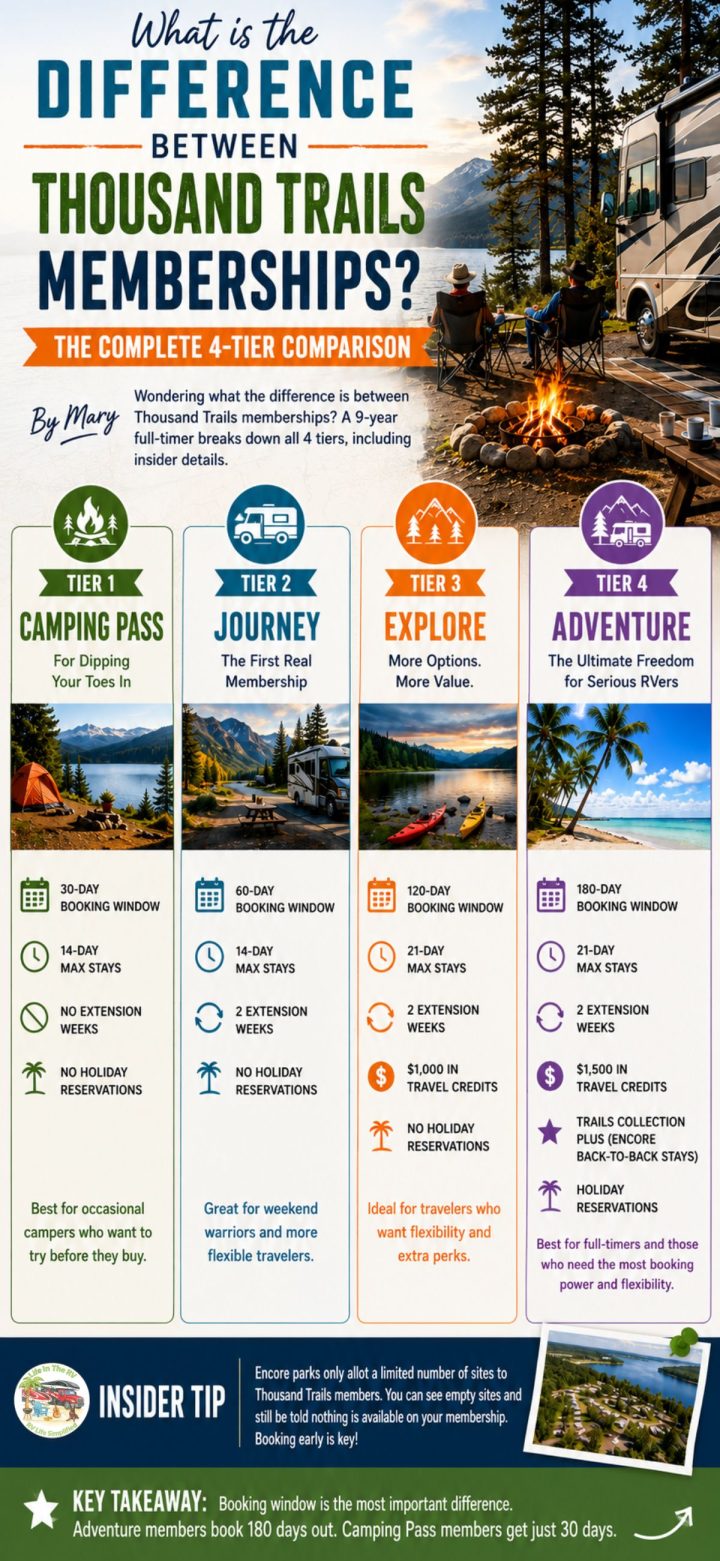
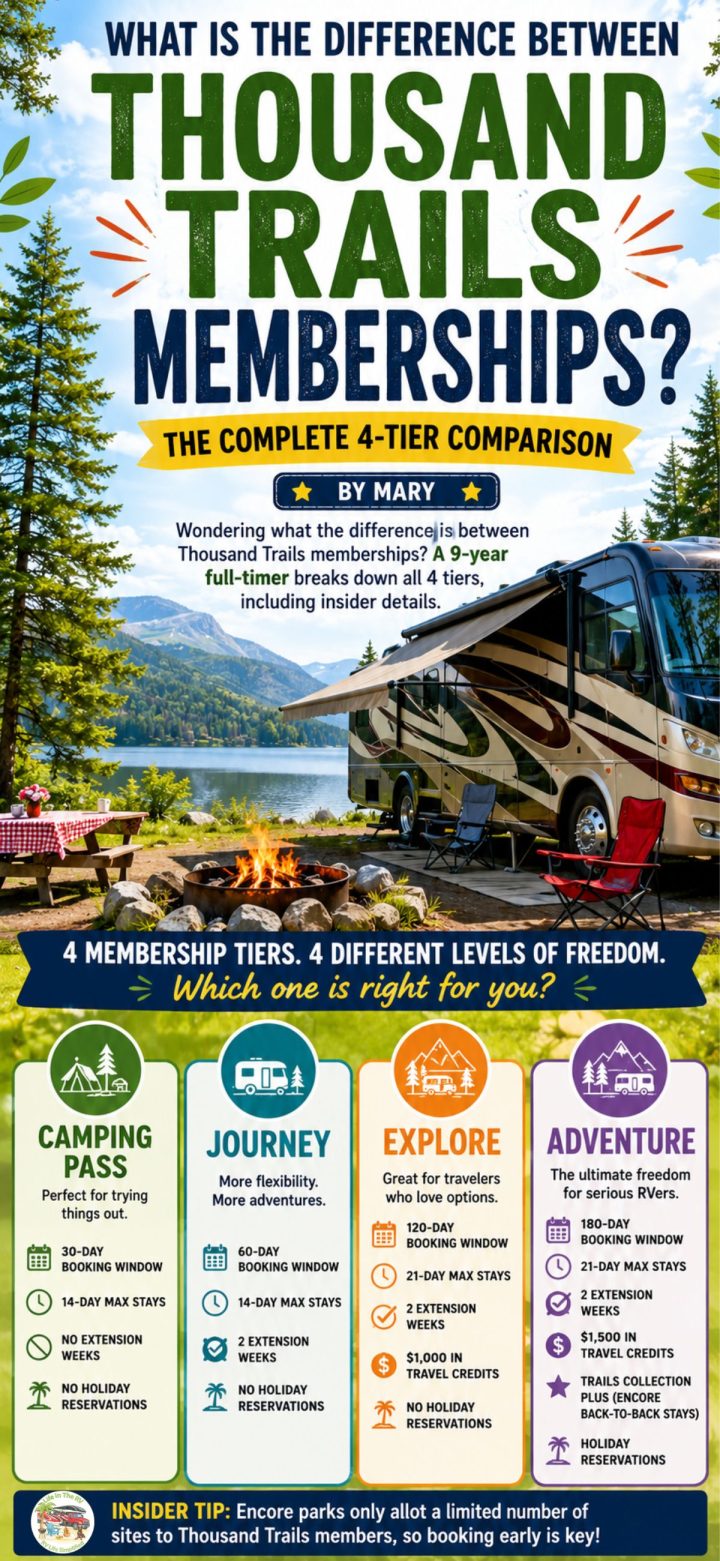
Wondering what the difference is between Thousand Trails memberships? A 9-year full-timer breaks down all 4 tiers, including insider details.
Thousand Trails Comparison: Camping Pass vs. Journey vs. Explore vs. Adventure
If you’ve spent more than 20 minutes on the Thousand Trails website trying to figure out which membership makes sense for you, you already know the problem: their own marketing does a surprisingly poor job of explaining the differences that actually matter.
Most comparison articles focus on the three upgraded tiers: Journey, Explore, and Adventure. But they skip the Camping Pass entirely, even though for a lot of aspiring full-timers it’s the first question worth asking: Do I even need a full membership, or will a Camping Pass do the job?
I’ve been living full-time in an RV for nine years. My husband Tim and I travel in a Jayco Seneca Super C, a big rig, which means campground access and site size genuinely matter to us in ways they might not for someone in a smaller setup.
Key Takeaways
- ✓ There are 4 Thousand Trails membership tiers: Camping Pass, Journey, Explore, and Adventure, each with very different booking power.
- ✓ The booking window is the most important difference; Adventure members book 180 days out; Camping Pass members get just 30 days.
- ✓ Encore parks only allot a limited number of sites to TT members – you can see empty sites and still be told nothing is available on your membership.
- ✓ Trails Collection Plus (Adventure only) lets you chain Encore stays back to back – critical for Florida or Arizona winter itineraries.
- ✓ Explore’s real value is its travel credits, not its booking window – it makes the most sense if you take non-RV trips or have family who’d use cabin stays.
- ✓ Big rig owners need the longest booking window possible to find and confirm sites that fit before they disappear.
- ✓ Most serious full-timers end up at Adventure – either because they started there or because they learned the hard way at a lower tier.
I’ve had direct experience with the Thousand Trails network, and I want to give you the straight-talk breakdown I wish I’d had before I started researching. All four tiers. No fluff. Just what you actually need to know.

What Is Thousand Trails, Anyway?
Thousand Trails is a membership-based camping network. Think of it like a Costco membership, instead of paying per visit, you pay an annual fee and gain access to a large network of private campgrounds. With RV park rates running $60–$100+ per night in many parts of the country, the math can work out very well for frequent campers and full-timers.
The Two Main Networks
Thousand Trails (TT) Parks: The core network of branded campgrounds. Your membership tier determines how far in advance you can reserve a site and how long you can stay.
Trails Collection / Encore Parks: A much larger, expanded network. Florida, for example, has only three TT parks, but over 30 Trails Collection/Encore properties. If you plan to winter in Florida, the Trails Collection network is where your itinerary lives.
The Hidden Detail Most People Never Know About
Here’s something most articles never mention: Encore parks only allot a limited number of sites to Thousand Trails members. The rest of the park operates as a regular paid campground. You might pull into a park and see dozens of empty sites, but still be told nothing is available for your membership. It’s not a glitch. It’s how the system is structured.
I spent nine years at Clerbrook in Florida, a beloved Encore park, and watched their member allotment drop from 140 sites down to 90. That’s 50 fewer spots available to members at one of the most popular Florida parks. You’re not competing for the whole park, you’re competing for a shrinking subset of it.
Keep this in mind as you read through the tiers, because it explains why booking windows matter even more than they look on paper.
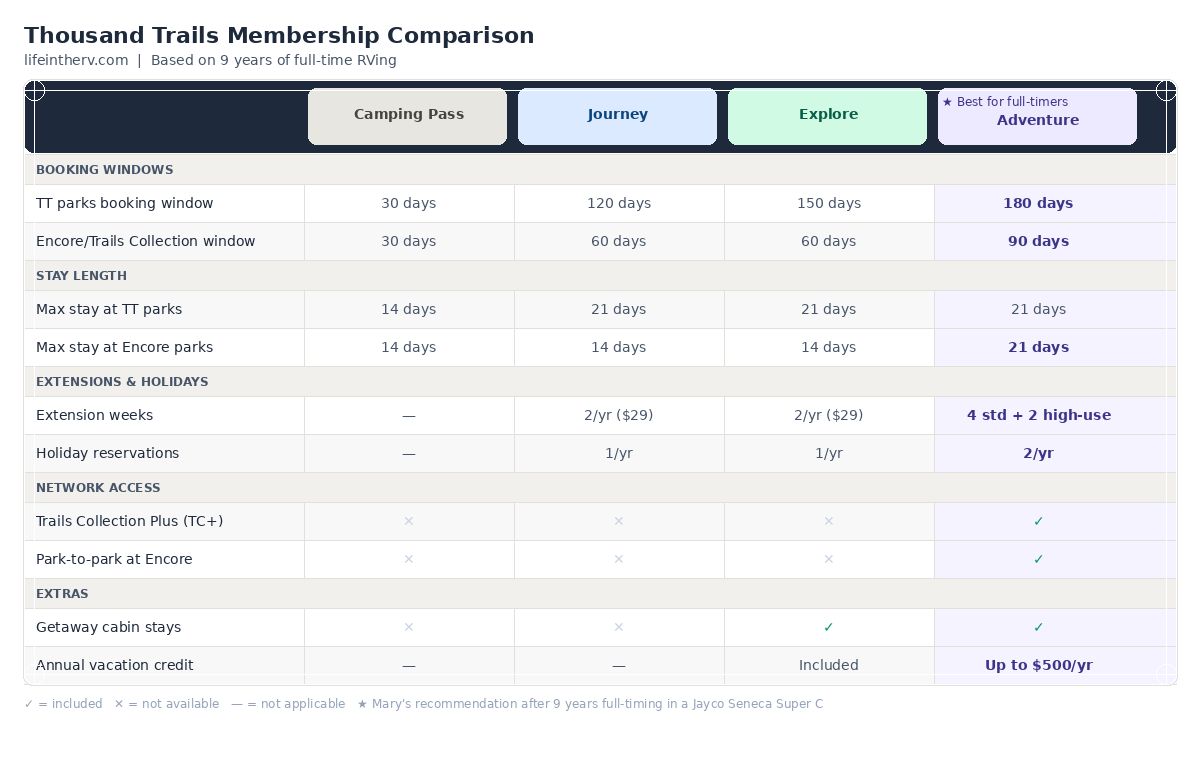
The Four Tiers at a Glance
Tier 1 — The Camping Pass: For Dipping Your Toes In
The Camping Pass is the entry-level option, and it tends to get dismissed quickly in most comparisons. For a specific type of person, it genuinely makes sense, but for full-timers, it almost always falls short.
What You Get
A 30-day booking window, 14-day max stays at TT parks, no extension weeks, and no holiday reservations. Think of it as a taste test of the network before committing to a full membership.
Who the Camping Pass Is Actually For
- You camp fewer than 20–30 nights per year
- You’re flexible with dates and not chasing popular parks during peak season
- You want to try before you buy
- You’re primarily staying in one region and don’t need wide geographic access
The Real Limitations
A 30-day booking window sounds fine in theory. In practice, the most popular parks, Florida wintertime properties, New England summer spots, anything near a major destination, fill up fast. Combined with the member allotment issue, you’re last in line for a pool of spots that’s already smaller than the park appears.
When I had a Camping Pass years ago, I couldn’t get into the Florida Keys parks I wanted. Not because the parks were full, but because the member allotment was gone long before my 30-day window ever opened. That’s a hard lesson to learn after you’ve already paid for a membership.
My honest take: The Camping Pass is a reasonable starting point for occasional campers who want to test the waters. It is not a long-term solution for full-timers, and if Florida or any high-demand destination is in your plans, the 30-day window combined with limited member allotments is a recipe for frustration.
Tier 2 — Journey: The First Real Membership
Journey is where most people start when they’re ready to commit to the Thousand Trails network. It’s the foundation membership, solid for regular campers, with meaningful upgrades over the Camping Pass.
What You Get
- 120-day booking window at TT parks
- 60-day booking window at Trails Collection/Encore parks
- 21-day max stays at TT parks (14 days at Encore)
- 2 extension weeks per year at non-high-use parks ($29 each)
- 1 holiday reservation per year
The Booking Window Reality
The jump from 30 days to 120 days is enormous. Four months of advance booking changes everything about how you plan your travels. You can sit down in August and plan where you’ll be in December, rather than scrambling to find whatever’s left a month out. For regular campers and weekend warriors, 120 days is genuinely plenty of runway.
Where Journey Gets Tricky
The 120-day window works great, until you’re competing against Explore members (150 days) and Adventure members (180 days) for the same popular sites. At high-demand parks during peak season, Adventure members have been booking for two full months before your Journey window even opens.
The holiday reservation situation is also worth understanding before you commit. Journey gives you one holiday reservation per year, and you can’t make your next one until you’ve actually checked in for your current one.
Use your one reservation on Memorial Day, and by the time you check in, the effective booking window for Fourth of July may be just 30 days away. Good luck finding availability at a desirable park on that timeline.
Extension Weeks at Journey
Two extension weeks per year at $29 each, usable only at non-high-use parks. The big limitation: Journey members cannot extend at high-use parks, exactly the ones you most want to stay at longer.
My honest take: Journey is a great membership for people camping 30–70 nights per year who aren’t chasing prime real estate during peak season. If Florida or Arizona winters are in your plan, be honest with yourself; you may outgrow Journey faster than you expect.
Tier 3 — Explore: The Most Misunderstood Tier
Explore is the middle tier that most people either dismiss quickly or choose for the wrong reasons. It serves a very specific type of traveler extremely well — and isn’t the right fit for everyone else.
What You Get
- 150-day booking window at TT parks
- 60-day booking window at Trails Collection/Encore (same as Journey)
- 21-day max stays at TT parks (14 days at Encore)
- 2 extension weeks per year at non-high-use parks ($29 each)
- 1 holiday reservation per year
- Getaway cabin stays included
- Travel credits toward non-RV travel
The Booking Window Upgrade
The jump from 120 to 150 days is real at TT parks. Explore members get 30 extra days of advance booking over Journey. However, the Encore booking window stays at 60 days, the same as Journey. So if Trails Collection parks are a big part of your itinerary, Explore gives you no advantage there.
The Part Nobody Talks About – Travel Credits
This is where Explore’s real value lives, and it gets glossed over constantly in every comparison post. Explore members receive Getaway cabin stays and travel credits applicable to non-RV travel through the RPI network.
If you occasionally take non-RV vacations or have family members who would use cabin benefits, the Explore tier can pay for its price difference over Journey before you ever book a single campsite.
Who Explore Is Actually For
Explore makes sense if you camp regularly AND you’d genuinely use the cabin or travel credits, non-RV trips, family members who’d use Getaway stays, or RPI condo trades. If none of those travel benefits apply to your life, the choice really comes down to Journey vs. Adventure.
My honest take: Explore is genuinely undervalued for the right person. If your life includes non-RV travel even occasionally, price it out before dismissing it. For pure RVers who won’t touch the travel credits, it’s a harder sell unless the 150-day TT window is specifically what you need.
Tier 4 — Adventure: The Full-Timer’s Membership
If you’re planning to live full-time in your RV — or if you’re serious about peak-season destinations, Florida winters, Arizona winters, or New England summers — Adventure is almost certainly where you’ll end up. Most full-timers who start at a lower tier eventually migrate here after their first hard lesson in booking-window math.
What You Get
- 180-day booking window at TT parks
- 90-day booking window at Trails Collection/Encore parks
- 21-day max stays at both TT and Encore parks
- 4 standard extension weeks ($29 each) + 2 high-use park extensions ($99 each)
- 2 holiday reservations per year
- Trails Collection Plus (TC+) — park-to-park access at Encore properties
- Getaway cabin stays included
- Up to $500/year in vacation credits
The 180-Day Booking Window
When Adventure members are scheduling their January Florida stays back in July, Journey members won’t be able to see that window for another two months. By the time a Journey member’s 120-day window opens for a high-demand Florida park in January, the prime sites, especially full hookups, which matter enormously in a big rig like our Seneca, may already be claimed.
We learned this the hard way with a Camping Pass and have not had a hookup issue since upgrading to Adventure.
Trails Collection Plus — The Game-Changer
Only Adventure members get TC+. Here’s what it unlocks: a 90-day booking window at Trails Collection/Encore parks (versus 60 days for everyone else), and park-to-park access at Trails Collection/Encore, meaning you can move directly from one Encore property to the next without a mandatory 7-day gap.
Florida has three Thousand Trails-branded parks. Three. The rest of your Florida winter runs through the 30+ Encore properties in the state. Without TC+, you cannot chain those Encore stays together.
There’s a mandatory 7-day exit between stays, meaning you’re paying out of pocket somewhere or scrambling for a bridge park every time you move. Adventure members with the TC+ chain Encore stay directly. No gap, no scramble, no unexpected expense.
Add the allotment reality, Clerbrook dropped from 140 to 90 member-allotted sites, and you can see why more booking runway directly translates to more actual availability.
Extension Weeks — The High-Use Advantage
4 standard extensions at $29 each, plus 2 high-use park extensions at $99 each, unique to Adventure. Journey and Explore members cannot extend to high-use parks at all. For us in the Seneca, not moving the rig unnecessarily saves real money in fuel and setup logistics.
Two Holiday Reservations
With one holiday reservation, you book Memorial Day, then can’t touch Fourth of July until you’ve checked in for Memorial Day, leaving roughly 30 days to find Fourth of July availability.
Adventure members book both simultaneously. Your entire summer holiday calendar gets locked in at once.
The $500 Vacation Credit
Up to $500 per year applicable to Getaway cabin stays, RPI condo trades, and other travel within the network. For couples or families who occasionally want a different type of trip, this can meaningfully close the price gap between Adventure and lower tiers.
Should You Buy a Used Lifetime Adventure Membership?
One option that doesn’t get talked about enough is buying a used Thousand Trails lifetime membership through Facebook groups. There are several active groups dedicated to buying and selling memberships, and deals come up regularly.
This is how a lot of serious full-timers get into the system; our friend picked up an Elite Basic lifetime membership for $3,000, which is a fraction of what a new membership costs.
Used lifetime memberships can run anywhere from $3,000 to $10,000 depending on the tier, age of the membership, and what’s included. That range exists for good reason; not all used memberships are created equal, and there are some important things to understand before you buy.
What to watch out for:
First, transfer fees. Every membership transfer comes with a fee paid to Thousand Trails, and it adds to your total cost. Factor that in before you decide what a listing is actually worth.
Second, not all used memberships include the extras. Some older memberships don’t include Trails Collection Plus, bonus weeks, or other benefits that come standard with a new Adventure membership. Read the details carefully and confirm exactly what transfers with the membership, not just the tier name.
Third, and this is the big one, some older memberships are no longer transferable at all. Thousand Trails has changed their transfer policies over the years, and certain membership types can’t be resold or transferred to a new owner. Always verify transferability before you get attached to a listing.
The older Elite and similar legacy memberships can be fantastic deals if the access holds up for your travel style. But do your homework. Ask in the Facebook groups, read the fine print, and know exactly what you’re buying before you hand over any money.
My honest take: The 180-day window, TC+ park-to-park access, and high-use extension weeks aren’t luxury upgrades; they’re the difference between a stress-free itinerary and constantly working around the system’s edges. Most serious full-timers land at Adventure. The ones who didn’t start there got there eventually.
Which Tier Is Right for You?
Choose the Camping Pass if…
You camp 20 nights or fewer per year, you’re flexible with dates, and you genuinely just want to try the network before committing. It’s a legitimate starting point, not a permanent solution.
Choose Journey if…
You camp regularly (30–70 nights/year), you’re not chasing peak-season availability at the most popular destinations, and you’re comfortable planning 4 months out. Journey works well for part-time RVers and those in the early stages of transitioning to full-time life.
Choose Explore if…
You camp regularly, AND the travel credits or cabin benefits genuinely match how your family travels. Price it against your actual non-RV travel spending before you decide; it may pay for itself before you book a single campsite.
Choose Adventure if…
You’re full-time or close to it, Florida/Arizona/New England peak season is part of your plan, you want full hookups at your first-choice parks without white-knuckling your booking calendar, and you want to stop engineering workarounds to move between Encore parks.
A Note on Pricing
Thousand Trails pricing changes, and they run promotions that don’t always show up publicly. I’m not publishing specific numbers here because they’d be out of date within months.
Run the math for your specific situation. If you’re currently paying $60–$80/night at RV parks and camping 100+ nights a year, the break-even calculation on an Adventure membership tends to come out looking very good.
The Super C Factor – A Note for Bigger Rig Owners
Since we travel in a Jayco Seneca Super C, I want to address something that doesn’t come up often enough: not all sites accommodate larger rigs. Many TT and Encore parks were built decades ago when rigs were smaller.
When you’re booking, check the site length and width specifications carefully.
The longer booking window becomes even more important in a larger rig because you need time to find and confirm a site that actually fits, not just any available reservation.
If you’re in a bigger rig, I’d lean even more strongly toward Adventure. The 180-day window and TC+ access give you the maximum amount of time to identify and secure sites that work for your setup before the good ones disappear.
So Which Thousand Trails Membership is for You?
Thousand Trails is a genuinely valuable membership for RVers who use it regularly. The key is matching the tier to your actual travel patterns, not your aspirational travel patterns, and not the version of your life that sounds good on paper.
Nine years in, I’ve learned that the systems and memberships that feel like logistics are actually what make this lifestyle work. Get that piece right and everything else gets easier.
Questions? Drop them in the comments. I’ve been doing this long enough to have made most of the mistakes, so you don’t have to.
Frequently Asked Questions
The main differences are the booking window, Trails Collection Plus access, holiday reservations, and extension weeks. Journey gives you a 120-day TT booking window and 1 holiday reservation. Explore adds a 150-day TT window plus travel and cabin credits. Adventure gives you the full 180-day TT window, a 90-day Encore window, 2 holiday reservations, high-use extension weeks, and Trails Collection Plus, which lets you move directly between Encore parks without a mandatory 7-day gap.
For occasional campers who are flexible with dates, it can be a reasonable way to try the network. For frequent campers or full-timers with specific destination plans, the 30-day booking window and limited member site allotments make it very difficult to get what you actually want. Most full-timers find it too limiting within the first few uses.
Yes, there are Trails Collection/Encore parks in the Florida Keys area. However, these are high-demand parks with limited member site allotments. With a Camping Pass (30-day window), it can be very difficult to book during popular seasons. With an Adventure membership and a 90-day Encore booking window, your odds improve significantly, this is one of our personal goals for the upcoming year.
Trails Collection Plus (TC+) is exclusive to the Adventure membership. It gives you a 90-day booking window at Encore parks (versus 60 days for all other tiers) and lets you move directly from one Encore park to another without a mandatory 7-day gap between stays. If your travel plans rely heavily on the Encore network, especially for Florida or Arizona winters, TC+ is essential, not optional.
Encore Parks only allocates a set number of sites to Thousand Trails members. The rest operate as a regular paid campground. Even if the park shows availability, if the member allotment is fully booked, you can’t reserve your membership. This is exactly why a longer booking window matters — the earlier you book, the better your chance of landing one of those allotted spots before they’re gone.
Camping Pass: 30 days. Journey: 120 days at TT parks, 60 days at Encore. Explore: 150 days at TT parks, 60 days at Encore. Adventure: 180 days at TT parks, 90 days at Encore (with Trails Collection Plus).
Yes, but the tier matters enormously. A Camping Pass is not well-suited to full-time life. An Adventure membership with a 180-day window, Trails Collection Plus, two holiday reservations, and high-use extension weeks is a completely different product. Most full-timers who use the membership successfully are on Adventure, plan well in advance, and use the system strategically.
Big rig owners need to be more selective about which parks and sites they book. Many TT and Encore parks were built decades ago when rigs were smaller. The longer your booking window, the more time you have to research specific sites, confirm dimensions, and lock in ones that actually fit your rig. For big rig owners, this is another strong reason to choose Adventure over lower tiers.
Save This Post for Later and Pin it to Your RV Memberships Pinterest Board
Affiliate disclosure: This post contains affiliate links. If you purchase through my links, I may earn a small commission at no additional cost to you. I only recommend products and services I personally use and believe in.