Full-Time RV Living Cost: Real Numbers, Real Life
What does full-time RV living actually cost? After 9 years on the road, here’s our honest breakdown of every expense category, plus the costs most people miss.
Full-Time RV Living Cost: What to Expect
If you’re seriously considering living in an RV full-time, one question almost always rises to the top: what does it actually cost?
You’ve probably seen wildly different answers online. Some people claim they live comfortably on very little. Others warn that RV life can cost more than owning a home. Both can be true, depending on how you travel, where you stay, the type of RV you own, and what level of comfort you expect.
After nine years of full-time RV living with my husband Tim and our German Shepherd Harley, and countless conversations with other RVers across campgrounds, rallies, service centers, and roadside coffee stops, one pattern shows up consistently: there is no single number that defines the cost of living in an RV full-time.

What matters far more is understanding the cost drivers, and learning how to build a realistic budget that matches your actual lifestyle rather than someone else’s.
This guide breaks down the real components of full-time RV living cost, explains what influences your monthly expenses most, and shows you how to estimate a sustainable budget without borrowing someone else’s spreadsheet.
🔑 Key Takeaways: Full-Time RV Living Cost
- There is no universal monthly number. Full-time RV costs range from under $2,000 to over $6,000 depending on rig size, travel pace, campground strategy, and lifestyle. Your number comes from your choices — not someone else’s average.
- Travel pace is the single biggest lever you control. Every move costs fuel. Moving less opens access to weekly and monthly campground rates. Slowing down is the fastest way to reduce your monthly total.
- Health insurance is the most underestimated fixed expense. If you’re leaving employer coverage, get a real quote for your situation before you build the rest of your budget. It’s a big number for most full-timers in the pre-Medicare years.
- Fund your maintenance reserve every month, even the quiet ones. Your home is a vehicle. Things break. The reserve is what separates a manageable inconvenience from a financial crisis.
- Memberships only save money if you do the math. Harvest Hosts, Thousand Trails, and others have real value — but only if your travel pattern actually supports enough usage to justify the annual fee. Calculate it for your situation before you buy.
- The first year costs more. Gear upgrades, systems refinement, and the learning curve are real. Give yourself a full year before drawing conclusions about what your ongoing budget will look like.
- Some of the biggest expenses go away entirely. Mortgage, property taxes, HOA, most utilities, home maintenance — gone. The budget doesn’t shrink, it reorganizes. Know both sides of that equation.

What Does Full Time RV Living Cost Per Month?
The monthly cost of full-time RV living varies based on travel pace, campground choices, fuel usage, maintenance planning, and personal spending habits.
Some RVers move frequently and chase seasonal destinations. Others stay in one location for months at a time. Some prefer full-service RV parks with amenities, while others embrace public campgrounds and boondocking.
A slower travel style generally keeps costs more predictable. Staying longer in one place allows access to discounted monthly campground rates and reduces fuel consumption and mechanical wear.
Faster travel increases fuel usage, accelerates maintenance cycles, and often involves higher nightly campground fees.
Instead of trying to find a universal average, the better approach is to identify what type of traveler you are and build your budget around those habits. That mindset creates more accurate expectations, and far fewer financial surprises once you hit the road.
| We share our actual monthly expense breakdowns so you have a real, specific data point with context, not a benchmark. Start with our April 2026 numbers: What Full-Time RV Living Cost Us in April 2026. |
What Are the Biggest Expenses When You Live in an RV Full Time?
Full-time RV living replaces traditional housing expenses with a different set of recurring costs. Understanding how these categories interact is the foundation of building a realistic full-time RV budget.
How Do Campground Choices and Boondocking Affect Your RV Living Budget?
Where you park your RV has the single biggest influence on your monthly budget. Private RV parks in popular destinations can command premium nightly rates, especially during peak seasons.
State parks, national forests, and public campgrounds offer more affordable options with fewer amenities.
Monthly campground stays frequently provide discounted rates and create budget stability. Many full-time RVers blend different camping styles throughout the year depending on weather, work needs, and personal comfort.
Memberships change the math significantly. Our Harvest Hosts membership, for example, shifts what a given month’s shelter costs look like, but those nights aren’t free, they’re pre-paid.
We track memberships separately from nightly campground fees so we can see what each strategy actually costs us.
Boondocking, camping without hookups on public land, can dramatically reduce campground costs while offering quiet, scenic locations. How much it works for you depends on your solar capacity, water management, comfort preferences, and the regions you travel.

Does Traveling Faster Make Full Time RV Living More Expensive?
Yes, traveling faster almost always increases full-time RV living cost, because fuel and maintenance accelerate together.
Fuel costs fluctuate based on how often you move, how far you travel between destinations, the size of your rig, and current fuel prices. In a Jayco Seneca Super C, fuel is never a background line item. It’s front and center every month, tied directly to how many miles we drive.
When diesel prices spiked, it genuinely changed how we travel, and it turned out those changes made us happier, not just cheaper.
Strategic route planning, seasonal migration patterns, and flexibility in travel timing all help stabilize fuel spending. We also use the Upside app on every fill-up, it’s not a magic savings tool, but over a year the cash back adds up to a real number we never leave on the table.
How Much Should You Expect to Spend on Food and Daily Living in an RV?
Food expenses in RV living often resemble household budgets, although limited storage and cooking space can encourage more intentional meal planning.
Cooking most meals inside the rig helps maintain predictable grocery spending, pulling a 40-foot Super C through a drive-through is not always the path of least resistance.
Daily living costs also include laundry, propane refills, campground incidentals, attraction admissions, and occasional household replacements that wear out faster in mobile life.
What Do Insurance, Registration, and Internet Cost for Full-Time RVers?
Full-time RV insurance differs from recreational policies and often includes expanded personal liability protection. Costs vary based on rig value, driving history, domicile state, and coverage selections.
Health insurance is the bigger surprise for most aspiring full-timers. If you’re leaving a job that provided coverage, you’re now looking at the full cost of an individual or family plan on the open market.
For most full-timers in the working years before Medicare eligibility, health insurance is one of the largest fixed expenses in the budget. Model it in early and model it honestly.
How Much Should You Set Aside for RV Maintenance and Repairs?
Many full-time RVers treat maintenance like a monthly savings category rather than a surprise expense. Your home is also a vehicle. It moves, vibrates, and lives outside in every kind of weather. Things break.
Every RV requires ongoing maintenance: tires age regardless of mileage, seals require regular inspection, appliances eventually fail, suspension components wear over time.
Even well-maintained rigs experience unexpected repairs. Establishing a dedicated maintenance reserve smooths these inevitable expenses and protects long-term financial stability.
We had our most expensive month ever when a significant repair hit. It wasn’t a crisis because we had the reserve.

Communications and Connectivity
Reliable internet and phone service are essential for navigation, weather monitoring, communication, entertainment, and remote work. Many RVers maintain multiple connectivity options to ensure coverage in rural areas, which becomes part of the monthly technology budget.
We spend more on communications now than we did with a home broadband line. It’s worth building in from the start.
The Costs That Aren’t in Most RV Budget Templates
Some expenses don’t appear in basic budget calculators. These are the ones that catch new full-timers off guard most consistently.
Mail, Domicile, and Legal Address
You need a legal address. You need mail handling. For full-timers, that usually means a mail forwarding service and a deliberate domicile state strategy. The three most popular states for full-timers, South Dakota, Texas, and Florida, each have no state income tax and RV-friendly registration systems.
Even among those three, costs differ. Getting your domicile strategy right before you go is worth the research investment; the ongoing savings can be significant.
Pet Costs on the Road
Harley goes everywhere with us, that’s non-negotiable. But traveling with a large dog adds costs that home-based pet owners don’t face the same way: per-night or flat pet fees at campgrounds, finding vet care in unfamiliar locations, and making sure every stop on our route is pet-friendly.
We break this out as its own budget line because it adds up across a year.
Dump Fees and Propane
When boondocking, dump fees are a real cost. Propane usage fluctuates with season, cold temperatures increase heating consumption, extreme heat raises electricity usage for air conditioning. Neither shows up in a nightly campground fee, and both need their own line.
The Convenience Premium
Life on the road occasionally puts you in situations where the convenient option costs more. Propane at whatever station is nearby. Groceries at the small-town store because the supermarket is 40 miles away.
Shipping to a campground address when delivery options are limited. No single premium is large, cumulatively, across a month and a year, they add a real number.
Temporary Lodging During Repairs
When your rig is in the shop for several days, you need somewhere to stay. Sometimes that’s a nearby campground. Sometimes it’s a hotel. Either way, it’s an expense that doesn’t appear in any budget template because it’s irregular, but it’s real, and it happens.

What Goes Away When You Go Full-Time
One of the things that makes RV living costs genuinely hard to compare to traditional living is that the budget isn’t just different, the categories are different. Expenses that existed in a house simply vanish.
- Mortgage or rent
- Property taxes
- Homeowner’s insurance (replaced by RV insurance, usually lower)
- HOA fees
- Lawn care and landscaping
- Most utility bills (electric, gas, water, sewer are typically included in campground fees or eliminated when boondocking)
- Home maintenance costs that aren’t RV-related
- A significant amount of ambient consumer spending that comes with living near stores and delivery infrastructure
That’s not a small list. For many people, those line items represent the majority of their monthly expenses. Going full-time doesn’t make your costs disappear, it reorganizes them around a completely different life structure.
How Does Your Travel Style Change the Cost of Living in an RV Full Time?
Your travel rhythm significantly impacts your budget. Here’s how the major styles typically shake out:
Slow Travelers
Moving every two to four weeks, or staying put for a month at a time. Lower fuel costs, access to weekly and monthly campground rates, more time to find local groceries and services at better prices. Often the lowest monthly totals of any travel style.
Moderate Travelers
Moving every one to two weeks. Enjoy flexibility with moderate cost variability. Fuel is a real but manageable line item. Campground pricing is a mix of nightly and weekly rates.
Fast Travelers
Moving every few days or chasing multiple destinations per month. Highest fuel costs, highest campground rates (typically nightly), fastest maintenance cycles. The most expensive way to travel, and for many full-timers, the most exhausting once the novelty wears off.
Understanding where you naturally fall on this spectrum, and being honest about it, is one of the most valuable things you can do before building your budget.
Why Does the Time of Year Matter So Much for RV Living Costs?
Seasonal travel patterns influence campground pricing, fuel availability, and even grocery costs. Popular winter destinations in the southern states often see higher campground demand and pricing, while northern regions peak during summer months.
Weather also affects utility usage. Cold temperatures increase propane consumption for heating, while extreme heat raises electricity usage for air conditioning. These seasonal swings affect monthly RV living expenses even when travel pace stays constant.
Geography plays a meaningful role too. Coastal regions, national park corridors, and metro areas often command higher campground fees due to demand and limited availability.
Rural regions and less-traveled areas typically offer more affordable options and greater boondocking access.
Many experienced RVers plan routes around shoulder seasons to reduce congestion and stabilize costs while maintaining comfortable travel conditions. Balancing high-cost destination travel with longer stays in more affordable regions helps smooth annual budgets.

Are Some States or Regions More Expensive for Full-Time RV Living?
Geography plays a meaningful role in full time RV living costs. Coastal regions, national park corridors, and metropolitan areas often command higher campground fees due to demand and limited availability.
Rural regions and less-traveled areas typically offer more affordable options and greater boondocking access.
Fuel prices, grocery costs, and service availability also vary regionally. Balancing high-cost destination travel with longer stays in more affordable regions helps stabilize annual budgets.
First-Year Costs Are Usually Higher
The first year of full-time RV living often carries higher startup and learning costs that don’t show up in any ongoing budget projection.
New RVers frequently invest in equipment upgrades, organizational solutions, connectivity improvements, and safety gear as they refine their setup. There’s also a learning curve in route planning, campground selection, maintenance scheduling, and weather navigation.
Mistakes during the first year may temporarily increase fuel usage or campground costs until systems become more efficient.
Over time, most RVers naturally optimize their budget as routines stabilize and preferences clarify. Give yourself a year before drawing firm conclusions about what your budget will look like long-term.
RV Living Costs by Household Type
Couples
Often benefit from shared space and utility efficiency. Two people share the same campground fee, the same fuel cost, the same rig maintenance expense. Per-person costs are typically lower than solo travel.
Families
Typically experience higher food, campground space, connectivity, and activity costs. Larger rigs required for families carry higher fuel and maintenance costs. School planning adds complexity and occasionally cost.
Solo Travelers
Often benefit from smaller, more fuel-efficient rigs and lower campground requirements. Still face all the fixed expenses, insurance, maintenance reserve, communications, that couples share. Per-person costs are typically higher than traveling as a couple.

Is Full-Time RV Living Cheaper Than Renting or Owning a Home?
Many people explore RV living as a way to reduce housing expenses. The honest answer is: it depends on what you’re replacing and what you’re adding.
Full-time RV living often eliminates mortgages, property taxes, large utility bills, and home maintenance, replacing them with campground fees, fuel, and RV upkeep. In high-cost housing markets, RV living can provide meaningful financial relief. In low-cost or paid-off housing situations, the difference may be smaller.
For us, our monthly total on the road has consistently been lower than what our previous housing life cost, while delivering a life we’d never trade back. But we’re also nine years in with systems dialed, a travel pace we’ve optimized, and memberships we use strategically.
Your first year comparison will likely look different than year nine. Build the honest version of both scenarios before you decide.

Emergency Savings and Repair Reserves
Emergency savings protect your flexibility and mobility, the two things that make this life work.
A common baseline is maintaining several months of living expenses plus a dedicated repair reserve separate from your general emergency fund.
Weather disruptions, medical needs, and mechanical failures are part of mobile life. Financial margin is what prevents small problems from becoming major disruptions.
We fund our maintenance reserve every month regardless of whether anything breaks. The months when nothing breaks, that money stays in the reserve. The months when something major goes, and those months exist, we’re not scrambling.
How to Build Your Own Full-Time RV Budget
Instead of copying someone else’s budget, build your estimate based on your lifestyle assumptions. Here’s how we’d approach it:
- Start with your rig. Motorhome or tow vehicle? Gas or diesel? Size and fuel economy determine your fuel budget range before you drive a mile.
- Decide on your travel pace. How often do you realistically want to move? That number drives fuel costs and campground rate access more than almost anything else.
- Map your campground strategy. What mix of paid, membership, and free camping matches your travel style and comfort level? Run the actual math on any membership before you buy it.
- Model health insurance honestly. If you’re not covered through an employer or Medicare, get a real quote for your situation before you build the rest of the budget around an unknown.
- Set your maintenance reserve. Not zero. A real number, funded every month.
- Add your fixed costs. Insurance, communications, mail service, domicile costs.
- Add your lifestyle costs. Food, entertainment, pet care, personal spending — based on who you actually are, not who you think you’ll become on the road.
- Add a buffer. The first year always has surprises. Build one in deliberately.
Start conservatively and adjust as real-world experience refines your numbers. Budgeting for RV life is an evolving process, not a one-time calculation.
The Costs That Aren’t in the Budget
Here’s the part that almost never makes it into RV cost posts.
There are things about this life that cost something, but not money. Distance from family. Missing events. The cognitive load of not having a permanent address. The emotional weight of repairs when you’re 800 miles from your usual mechanic.
I don’t say this to scare anyone off. Tim and I chose this life deliberately and we’d choose it again. But if you’re running the numbers and they look good, also run the other numbers, the ones that don’t go in a spreadsheet. The financial math is the easy part.
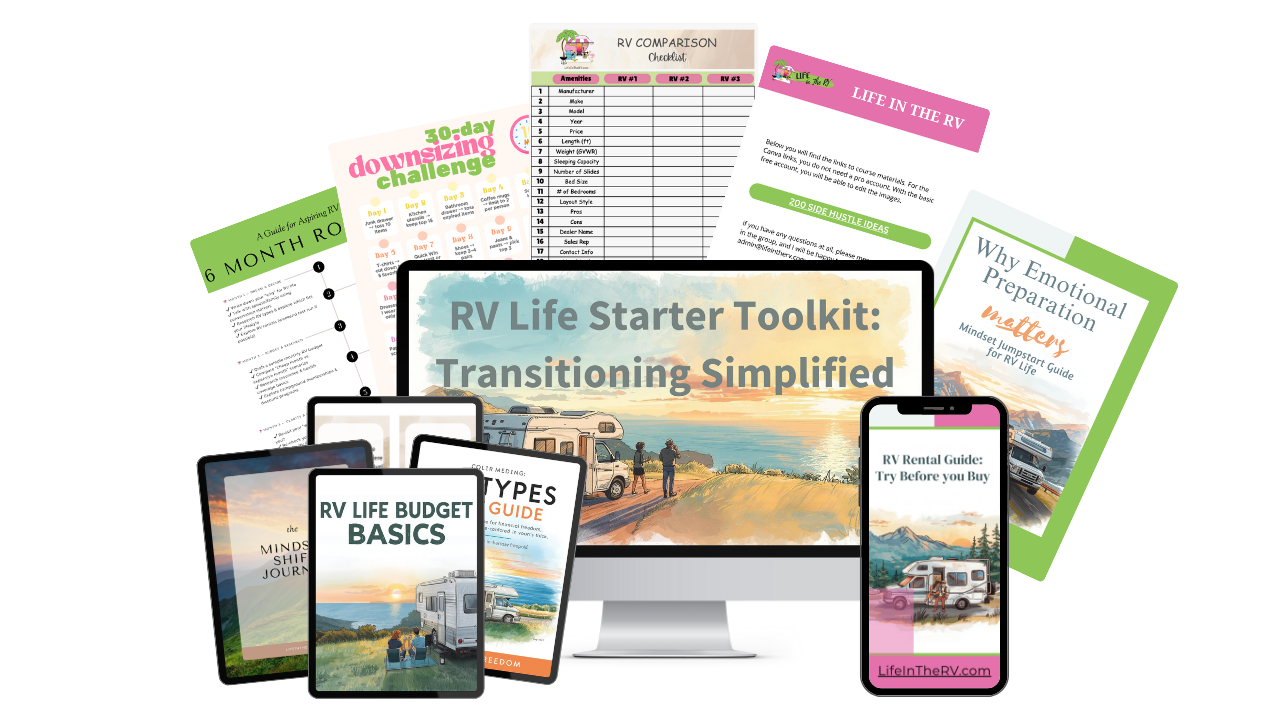
👉 If you’re ready to start turning these numbers into a real plan, the RV Starter Toolkit walks you through your next practical steps, from clarifying your budget to organizing the logistics, without overwhelm.
Follow us on Pinterest and PIN any of these images for later!


Frequently Asked Questions About Full Time RV Living Cost
Beginners often experience wider cost variation during their first year as they learn travel rhythms, campground preferences, and equipment needs. Startup costs for gear upgrades, systems refinement, and the learning curve are real. Expenses typically stabilize as routines develop — give yourself a full year before drawing firm conclusions about your ongoing monthly average.
In many high-cost housing markets, RV living can be more affordable than renting, especially when slower travel and monthly campground stays are used strategically. However, the comparison depends heavily on your location, lifestyle, health insurance situation, and travel pace. The honest answer is: build both budgets with real numbers before deciding.
Campground fees and fuel are typically the largest variable expenses, and both are directly controlled by travel pace. For full-timers without employer-provided coverage, health insurance is often the largest fixed expense. Together, these four categories — campgrounds, fuel, health insurance, and maintenance reserves — drive the majority of most full-timers’ monthly totals.
Yes, many RVers significantly reduce costs through boondocking, slow travel, cooking most meals at home, campground membership strategies, and selecting modest campground options. The lowest realistic monthly budgets require flexibility in location, comfort with dry camping, and a deliberate approach to every spending category. It’s achievable — but it requires intentional choices, not just hoping costs stay low.
Most experienced full-timers recommend maintaining at least three to six months of living expenses plus a dedicated repair reserve. RV repairs can range from a few hundred to several thousand dollars with little warning. A funded reserve is what separates a manageable inconvenience from a financial crisis — and it needs to be rebuilt after each draw.
Does travel pace really change costs that much?
Dramatically. Travel pace is the single most impactful controllable variable in an RV budget. Every move costs fuel. Frequent moves prevent access to discounted weekly and monthly campground rates. In a large motorhome or diesel rig, the fuel math alone can create a difference of hundreds of dollars per month between a slow and fast travel pace.